Showing posts with label education. Show all posts

Friday, July 6, 2018

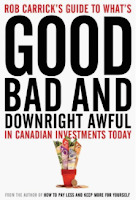
Review: Good Bad and Downright Awful in Canadian Investments Today

Rob Carrick is arguably Canada's best known financial writer.  He describes his column in the Globe and Mail this way: "one regular guy’s attempt to make sense of the world of money." He has been writing about financial issues for about 25 years, and has been the Globe and Mail's Personal Finance columnist since that feature began.

I daily read his contributions in the Globe & Mail, finding his writing direct, clear, well researched and valuable. I also follow him on Twitter (his handle is @rcarrick).  As I have noted a number of times on this blog, I find his annual ETF Guides a valuable resource for Canadian investors.

Not long ago I finally got around to reading his book Rob Carrick's Guide to What's Good, Bad and Downright Awful in Canadian Investments Today (Doubleday Canada, 2009 ISBN 978-0385667456).  The book is available in both Kindle and printed formats.  Although the book was written some years ago, it has not been updated, although he has written a more recent book aimed at millenials: How Not to Move Back in With Your Parents: The Young Person's Complete Guide to Financial Empowerment (Doubleday Canada, 2012).

What's Good


Rob Carrick is noted for his direct, clear and well-researched writing. As the title implies, he is not afraid to sharply criticize when he feels the criticism is warranted. I would say that the direct and open approach is the greatest strength of the book.  If you like his columns in the Globe, you will like this book, as the tone is not surprisingly similar.

The book is positively reviewed on Amazon, with a rating of better than 4/5 stars.  Most comment on the succinct, direct and clear writing style, with occasional use of humour.  Several reviewers do point out that this is essentially a book for those getting started in investing, and it should be followed up with a more detailed and current book.

A true Canadian investing champion, Dan Bortolotti, CFP, CIM of Canadian Couch Potato fame, had this praise for Carrick and this book in a review:
"Rob Carrick is one of a small number of journalists who stand up for individual investors in this country. If you’re not a regular reader of his columns in the Globe and  Mail, I encourage you to start. His latest book, Rob Carrick’s Guide to What’s Good, Bad and Downright Awful in Canadian Investments Today (Doubleday Canada), is classic Carrick: straightforward, easy to read advice that doesn’t kiss any asses in the financial industry. The book is perfect for browsing, because it’s organized into lists such as “Seven dumb rookie mistakes investors make and how to avoid them,” and “Ten signs of a rotten adviser.” Here’s one of his assessments: “If an adviser isn’t an indexing adherent, then he or she should at least recognize the value of this investing approach. The test is whether an adviser trashes indexing, and many will. If this happens, then keep looking.”

Keep in Mind


Do keep in mind that this book was written about ten years ago, so the details of things like MER are not current(fortunately expenses in the investing world have come down dramatically in the last few years). Also, there are even better ETF choices than at the time this book was written (and far more ETF possibilities for Canadians). Therefore while you should read this book for general advice, not as a practical guide to specific investments. Also, while you will find some new gems in his listing of online resources, his list reflects, naturally, the era when this book was written.

Final Thoughts


If you are just starting out investing, do read this book. For a beginning Canadian investor I would place this book in the first ten books to be read.  If you don't want to buy your own copy, you can probably find it at your local library or inexpensively at a used bookstore - don't feel too badly about Rob Carrick missing out on additional royalties, I suspect that he would be happy that you are being frugal and saving money!

In an earlier review of a different book, I mentioned that after reading a book I ask myself the following four questions.
  1. Was my time invested in the book, time well spent?
  2.  Do I have confidence in the validity and balance in the presentation? 
  3. Was I engaged in the book? 
  4. What were the author's motives in writing the book? 
I enthusiastically answer YES to the first three questions.  This book is a quick read (at least for those with even a modest investing background), and I felt my reading time was indeed time well spent. Even if you consider yourself an experienced investor, you will still find value in this book.

While I don't always agree with everything Rob Carrick writes (in this book or in his columns in the Globe), I do have confidence that he genuinely cares about the welfare of Canadians, and that he has thought out and researched what he writes.  While he does express strong opinions, I do feel that there is balance in his writing. While any author hopes to have some financial success with a book, I feel that Rob Carrick, first and foremost, wants to help individual investors have success and avoid blunders. He wants them to be empowered to make good financial decisions.

As well as this book, check out Rob Carrick's website which links to his books, and tells you more about his background.

On his website Rob Carrick promotes his writing this way:
"My willingness to challenge stale consensus thinking and, most of all, my ability to make you say after finishing one of my columns: 'Now I understand.'"
Indeed that would be a good description for the content of this book.

So why not give Rob Carrick's Guide to What's Good, Bad and Downright Awful in Canadian Investments Today a read? While many years since publication, it is readily available in both new and used forms.  If you have not already read the book, put it on your list for summer investment reading. It will be time well spent! While details like specific investment products and costs change over time, the sound investment principles Rob Carrick advocates in this book are timeless.  

This posting is intended for education only and should not be considered investment advice. The reader is responsible for their own financial decisions.  The writer is not a professional financial planner or investment advisor. For major financial decisions it is always wise to consult skilled professionals. While an effort has been made to be accurate, any statements of fact should be independently checked if important to the reader.

Disclosure:  No compensation by any company, organization or individual has been offered, requested or received for writing this column. We do however belong to affiliate programs for some of the links that you find in our articles, details available upon request.

Books for Review: I will not promise a positive, or even any, review, but if you wish to submit your investment book for me to consider, contact me rhawkes (at) chignecto.ca. I am particularly interested in Canadian books.


Wednesday, July 4, 2018

Review: A Wealth of Common Sense


Ben Carlson is an investment writer who consistently has something important to say and expresses it in an engaging way.  Each morning I eagerly await his new post in my email, and he is one of the financial writers that I follow most closely on Twitter. I am in awe at the volume and quality of his writing.

Ben is Director of Institutional Asset Management at Ritholtz Wealth Management.  He has authored both the book reviewed here, A Wealth of Common Sense: Why Simplicity Trumps Complexity in Any Investment Plan, and also Organizational Alpha: How to Add Value in Institutional Asset Management. Ben Carlson has been recognized in numerous awards, including being chosen in 2017 for Investment News 40 Under 40. You can read more about his background on his website.

Ben Carlson and Michael Batnick, also of Ritholz Wealth Management, have a weekly podcast that goes by the unusual title Animal Spirits.  The style of the podcast is very different from that of this book, and from his daily investment posts.  I may review the podcast at some future date. I suspect many came to Ben Carlson's considerable social presence after reading one of his books, but for me it was the opposite: I first started reading his blog and twitter posts. I decided it was finally time to seek out his best known book and to do a review on it.

Sometimes books have clever titles and sometimes they use descriptive titles.  This title is both. Essentially the book emphasizes the point that a clear investment plan, patience over the long term, and sound investment choices will yield good long term returns.  Success is largely dependent on making good common sense choices, and reigning in our emotions.

Essential Ideas


In the introduction to the book he summarizes simple and effective investment advice in the following points.
  • Think and act for the long term.
  • Ignore the noise.
  • Buy low, sell high.
  • Keep your emotions in check.
  • Don't put all of your eggs in one basket.
  • Stay the course.
As he emphasizes, the challenge is not so much to know those points, essentially common sense, but rather how to follow them.

In clear engaging language he outlines some of the traits listed below that you must reign in.  Here are the key messages, but read the book to get the details.
  1. Looking to get rich in a hurry.
  2. Not having a plan in place.
  3. Going with the herd, instead of thinking for yourself.
  4. Focusing exclusively on the short term.
  5. Focusing only on those areas that are completely out of your control.
  6. Taking the markets personally.
  7. Not admitting your limitations.
He goes on to provide the flip side - what are the traits of a successful investor?
  1. Emotional intelligence.
  2. Patience.
  3. Calm during times of stress.
  4. The ability to say 'I don't know.'
  5. Understand history.
  6. Discipline.

What I Like


Ben Carlson devotes considerable attention to dealing with our emotional sides. As he says in the chapter on contrasting individual and institutional investors.
"One of the biggest mistakes investors make is letting their emotions get in the way of making intelligent investment decisions."
The following chapter is entirely devoted to the traits required to be a successful investor. That chapter opens with this great quote from Charlie Munger:
"If you can get good at destroying your own wrong ideas, that is a great gift."
-Charlie Munger
By clearly laying out the key traits of unsuccessful and successful investors, the author has set a superb foundation, with much of the book weaving the details around those points and the evidence for them.  I find that this approach works really well.

Ben Carlson appropriately stresses that in order to get more reward, indeed to get enough reward to overcome inflation, you need to take on some risk. I like the emphasis he places on market history as part of your investment education. That historical emphasis is also one of the Four Pillars of Investing of Dr. William J. Bernstein (see my review of that book here). Chapter 4 of A Wealth of Common Sense on market myths and history is one of my favourites. Many of these deal with timing attempts (read the book!), but I will share his fifth myth, which I think is something important that simplistic advice often overlooks: Myth 5 Stocks and bonds always move in different directions (see also Myth 7 which deals with risk inherent in stocks and bonds).

A Wealth of Common Sense is more scholarly (in a good way!) than many investment books.  Each chapter has an extensive list of resources to support the points made, ranging over books, articles and websites.  The author clearly reads widely and with an open mind, and that shines through in almost every page of this book.

In a book that pays attention to the evidence supporting ideas presented, sometimes it is easy to loose track of the key ideas.  Ben Carlson guards agains this by including for each chapter a Key Takeaways section, a few bulleted points that emphasize the key ideas of the chapter.

As would be expected,  Ben Carlson stresses the importance of development of an informed financial and investment plan.  A part of this is defining yourself as an investor (Chapter 5 has a section with this heading). As he says "...there is never going to be a one-size-fits-all investment philosophy for every person." He suggests that asking yourself questions such as does your investment philosophy match your personality and individual circumstances, and what constraints do the conditions of your life place on that philosophy.

The book contains many superb pithy quotations, such as the following in a section on The Benefits of Doing Nothing.
"Lethargy, bordering on sloth, should remain the cornerstone of an investment style."
–Warren Buffett
I find that the book concludes strongly, with the Exhibit approach in Chapter 6, including gems like the mutual fund graveyard and picking one active fund is hard, followed by Chapter 7 on asset allocation, and then Chapter 8 on a comprehensive investment plan.  Chapter 7 provides a solid foundation in evidence, history and principles guiding an appropriate asset allocation for your own personal situation. Chapter 8 includes coverage of lifecycle investing, and the different situations for investors at different stages in life.

The penultimate chapter looks at the key question of if you should seek professional advice, and how to interact with your financial advisor. His key takeaways for this chapter include advice such as "look for self-awareness and humility, not certainty or guarantees" and "outsourcing to a financial advisor is intelligent behaviour if you don't have the time, expertise, or emotional control to implement an ongoing financial plan."

The book provides good balance, with sage advice such as the following:
"Your investment plan should be designed specifically... for you – build the one you know you will follow. You have to be brutally honest with yourself about your ability to handle risk."

A Few Reservations


This is not so much a reservation as a caveat that this is not a simplistic 'how to' investment book.  Don't expect it to lead you into precisely what you should do with your investment portfolio. But perhaps that reservation is really a strength – as investors we need to educate ourselves and develop personally appropriate financial and investment plans. While he does not guide you in precise financial products, the author (in  Chapter 5) does offer a checklist of the traits of a good fund (applicable to both mutual funds and exchange traded funds). He suggests that you should seek low cost, rules-based and transparent, evidence supported, liquid investments.

While I liked a lot of the structure of the book, for me at least, I found that Chapter 1, The Individual Investor versus the Institutional Investor, was not the most engaging way to start the text.  I would have started with either Chapter 2, on the traits of successful investors, or possibly with the content of Chapter 3 on long term performance and the link of risk and return.

For Canadians, this book is of course written from a U. S. perspective.  Nevertheless, the vast majority of the points made are applicable in different countries and economies. I will be reviewing a few Canadian authored investment books in the coming weeks.

Concluding Thoughts


How is investing like walking into a restaurant? Read the beginning of Chapter 6 to find out! Along the way you will learn some valuable insights about the investment industry.

Most good books are common sense, and this is no exception. The book is full of concisely presented evidence as well though.  For example, in the decade ending in 2013 there were a total of 6911 mutual funds opened, but over the same period 3066 funds were merged, and 3105 were liquidated. Survivorship bias is indeed a thing.

A message that I fear many investors will need to keep in mind during the coming decade is the following:
"The only true guarantee we have in the markets is that things will go wrong and people's perception of risk will be in a constant state of change. Risk is actually more predictable than returns."
At the outset of the Conclusion chapter he mentions that someone offered him the following advice as he was writing the book to imagine that his grandmother came to him for investment advice, asking for 10 things that she could understand and that were important.  Maybe that explains a lot of why this book is as good as it is! You will need to get the book to see the full list, but number one is "Less is more" and the second is "Focus on what you can control."

The investing great Warren Buffett once said:
"Hang out with people better than you, and you cannot help but improve.'
–Warren Buffett
I strongly encourage you to 'hang out' with Ben Carlson through reading this book! Ben Carlson has 'hung out' with a lot of investment giants, and this book is our shortcut to reaping some of the benefits of that. And since more hanging out with good people is always a good idea, the book ends with a book list of great choices to move onto after this book.

The 224 page book, published in 2015 by Bloomberg/Wiley, is widely available through bookstores and libraries, or can be purchased through Amazon. It comes in hardcover (ISBN 978-1119024927), softcover and Kindle eBook formats.

Downtown Josh Brown, of The Reformed Broker fame, praises the book and Ben Carlson through these words:
"True investing wisdom—born out of experience and success—cannot be faked; it must be earned. This is precisely the type of wisdom that comes oozing out of every chapter in A Wealth Of Common Sense." 
I totally agree. This book would be in my top 5 investment books for an individual investor. Why not make it part of your summer personal finance and investment reading list?


This posting is intended for education only and should not be considered investment advice. The reader is responsible for their own financial decisions.  The writer is not a professional financial planner or investment advisor. For major financial decisions it is always wise to consult skilled professionals. While an effort has been made to be accurate, any statements of fact should be independently checked if important to the reader.

Disclosure:  No compensation by any company, organization or individual has been offered, requested or received for writing this column. We do however belong to affiliate programs for some of the links that you find in our articles, details available upon request.

Books for Review: I will not promise a positive, or even any, review, but if you wish to submit your investment book for me to consider, contact me rhawkes (at) chignecto.ca. I am particularly interested in Canadian books.


Thursday, May 18, 2017

Financial Literacy Courses – A Bad Idea?

In an interview on CBC The 180,  Daniel Munro, Associate Director, Public Policy at The Conference Board of Canada, and an ethics lecturer at the University of Ottawa, asks the question: Do mandated high school financial literacy courses do more harm than good? I urge you to listen to the podcast of the entire episode, and read the piece he wrote for Macleans on the same topic, but essentially he bases his argument on three points.
  1. As usually structured, such courses give an incorrect view that making good financial choices is all that is important (neglecting circumstances). 
  2. The evidence suggests that the positive impact of mandatory financial literacy courses is short lived.
  3. There may be misplaced over-confidence from taking a single financial literacy course, actually contributing to bad financial choices made later in life.
In March I argued that we need more financial literacy, and I stand by that assertion. I am glad to see that in various parts of Canada there are new initiatives to support enhanced financial literacy.

However, I think that Daniel Munro's interview is a wake up call to make sure that we have the right sort of financial literacy education. Also, we must do the research to make sure that financial literacy courses are actually contributing to improved long term outcomes.  Let us look at the three points from the Daniel Munro interview.

(1)  He argues that courses, at least as currently formulated in the grade 10 course about to become mandatory in Ontario, place too much emphasis on just one element of financial decisions, making good choices.  While clearly good choices matter, he argues that this emphasis in the absence of a consideration of circumstances, is at best incomplete.  Circumstances of many types, including family circumstances and obligations, costs of living in your region, educational opportunities, natural abilities, and much more, all contribute to the right financial decision in a situation. In his Macleans piece Daniel Munro states the case clearly and powerfully as follows:
"...fairness and responsibility argue that while people ought to be responsible for what results from their choices, they should not be responsible for what results from circumstances that are beyond their control..."

(2)   With respect to the long term impact of mandated financial literacy courses, he points out in the Macleans piece that research evidence supports the idea that financial literacy course impact is limited.  He mentions a meta analysis of 168 research papers covering more than 200 studies on effectiveness of financial literacy courses.   While I have not read that analysis in detail, I am familiar with this report by Shawn Cole, Anna Paulson, and Gauri Kartini Shastry that looked at the effectiveness of mandated financial literacy courses in the US, where in some states there is a history of sufficient length to study such effects. The report is a white paper of the Harvard Business School, and is entitled High School Curriculum and Financial Outcomes: The Impact of Mandated Personal Finance and Mathematics Courses. I quote from part of the abstract of the paper that gives a clear indication of the results:
"Financial literacy and cognitive capabilities are convincingly linked to the quality of financial decision-making. Yet, there is little evidence that education intended to improve financial decision-making is successful...this paper answers the question 'Can good financial behavior be taught in high school?' It can, though not via traditional personal finance courses, which we find have no effect on financial outcomes."
Interestingly, the paper goes on to show that more mathematics education can lead to enhanced long term improvements in financial decision making and investment participation.

(3)   We all know that over-confidence can be dangerous, and this certainly applies to financial decision making.  Daniel Munro cites a 2014 study by Marc Kramer that found that
"...confidence in ones‘ own (financial) literacy is negatively associated with asking for help, while actual expertise does not relate to advice-seeking"
While I firmly believe that finance and investment education is a positive, his remarks remind us that part of that education must be a clear understanding of the limitations of understanding, and the value of seeking advice.  As mentioned in my previous post,  I prefer a spiral approach to financial education, starting in elementary school and extending throughout life.

I believe that mathematics education has a longer impact than financial literacy courses due to two factors.  Mathematics education tends to be taught in a very active learning mode: most mathematics educators realize that you learn math by doing math (including discovering some relationships on your own), not by having it explained to you.  There is an important lesson here for financial literacy teachers.

The second reason is that mathematics education emphasizes concepts and techniques with broad application, and through those applications it keeps getting used regularly. I think that a similar approach is necessary for successful financial literacy courses, and "one of" financial literacy efforts will be doomed to failure.

I have been working for some time on a future post that will present my ideas for a different kind of university based financial education course.  That will stress active learning, quantitative reasoning, and the link between financial decisions and positive public policy. Sign up to follow this blog and you will receive each new post directly to your email, complete with all hyperlinks (and no advertisements!).

I would love to hear your opinions, either through the comment section or through an exchange on Twitter.

 The writer is not a financial planner or investment advisor, and reading this column should not be interpreted as obtaining individual financial planning or investment advice.  While an effort has been made to be accurate, any statements of fact should be independently checked if important to the reader.

Added note: I have added material to the original posting based on his Macleans article, and the linked studies therein, that I did not know about at the time of the original posting.

Sunday, April 2, 2017

Your Plan Starts With Goals

Financial planning experts agree that having a plan is essential, and that it is important to periodically revisit that plan. As with many things in life, it is never too late to start with a financial plan.  My main point in this short post is that your plan should not start money, but rather with your life goals. It works best if your plan is in writing.

Life Goals

Start with the big picture. Each plan will be unique, since each of us is unique, but the following questions may be helpful.

  • Who are the most important people in your life?
  • What in life is most important to you?
  • Who else are you, or might you be, responsible for, and what are their needs?
  • What organizations and causes do you want to support?
  • What are your career aspirations, and what do you need to get there?
  • What age do you hope to retire, and do you see retirement as a partial or full retirement from paid work?
  • What makes you happy?
  • What special needs to do you have?

Getting There

After you have your life goals established, the next step is to make a reasonable series of financial estimates of what you will need to achieve your goal.  For example, if you want to fully retire at a certain age, make reasonable estimates of how much you anticipate needing. Keep in mind that OAS and CPP will get you part way there.  Then use a calculator such as this one from Financial Post to estimate how much you need to contribute each year to meet your goal. 

Other goals will be easier to estimate.  For example, perhaps you want enough for a down payment on a house of a certain price in five years time, or want to build up an emergency fund to cover 9 months of expenses.

Some may be more complex - for example you want to be able to quit your job and start up a business. You need a reasonable business plan not just for startup funds, and income replacement, but also to anticipate possible business losses in early years and a contingency fund.

Not Just One Plan

I think that having multiple parallel plans works best for many of us.  For example, have one retirement plan, another that is a plan for education savings, a plan to work toward a major housing goal,  a plan for helping causes important to you, etc. Clearly the different plans must make sense when taken together with your resources, but it is often simpler to establish the way forward when we view it as a series of parallel paths. Also, I think it is more encouraging to see that progress has been made in meeting some goals, even when we have fallen short on others.

Some argue that multiple plans add complexity, but I think the opposite is true.  It is simpler to look at our financial goals and progress as a series of parts, and then view the big picture as the sum of those parts.

Rebalance Your Life Plan

Just as we are advised to rebalance investments annually, you should revisit the life goal aspects of your plan periodically.  Evaluate whether your goals or circumstances have changed, and make changes to your plan. One advantage of your plan being in writing, even if as simple as a bullet list of items, is that it makes it easy to see whether you are on track, and where changes are needed.  I have never done this personally, but I know of people who set a date, like New Year's, for a formal reconsideration each year, and I think that makes a lot of sense.

Know When To Hold and When To Fold

While plans are important, they can and should be changed. As the Kenny Rogers The Gambler lyrics suggested
"You've got to know when to hold 'em  
Know when to fold 'em"
I think that some of us don't know when to hold them, when to stay firm to goals, even when things seem difficult. But some of us are also too resistant to change goals, even when, deep down, we know we should.

Maybe something that was important to you, is no longer so important.  Perhaps you have new priorities.  Maybe you have changed your mind and want to retire earlier or later. Sometimes conditions require us to change our plans - for example after the market crashes some had to postpone retirement, or make it a partial retirement.

Resources for Developing a Financial Plan

I don't personally like the financial priority and order in some of these processes, but the following are valuable background for developing your financial plan.
  1. WikiHow have a clear and attractive article on developing a financial plan. I particularly like their emphasis on SMART.  Is it Specific, Measurable, Achievable, Rewarding and Timely
  2. The Moneysense Financial Plan Kit is surely one of the most complete guides out there, and well thought out.  They provide a series of Word of PDF documents to help you create a plan in 11 steps.
  3. Although not as prescriptive as the above, the finiki document on Creating a Financial Plan is Canadian with good information on a number of aspects of your plan.
  4. Want to see what an award winning financial plan looks like? See this great Canadian financial plan here.

Closing Thoughts

Life is not about investments.  Investments are tools, nothing more (or less).  They are tools that allow you to care for others, to provide educational opportunities, to feel secure in your retirement, to allow independence, to support organizations and causes important to you.

Whether you want to engage a professional financial planner to assist you with the plan is a matter of personal preference.  If you are making the plan yourself, make sure that you use valid sources to help you with quantitative aspects of your plan.

For many it makes sense to start the life plan goals on your own, but then get a professional financial planner to help estimate how much you will need, and how to get there financially. You can find a CFP® (Certified Financial Planner) in your area here. I would not count on an advisor who has a stake in your investments to help you with a financial plan.

If you do use the services of a professional planner, always keep in mind that it is your plan and you must take ultimate responsibility for your plan.  She or he may help you develop the plan, but never ask (or let) an advisor to make the plan for you.

This posting has considered developing a life plan, and a little bit about the financial needs for that plan.  After that part of your plan is complete, you also need an investment plan, that will guide how to invest your savings consistent with your life plan.  We will cover investment plans in a future post.

Happy planning!

This posting is intended for education only and should not be considered investment advice. The reader is responsible for their own financial decisions.  The writer is not a professional financial planner or investment advisor, and reading this column should not be interpreted as obtaining individual financial planning or investment advice. For major financial decisions it is always wise to consult skilled, impartial professionals. While an effort has been made to be accurate, any statements of fact should be independently checked if important to the reader.


Thursday, March 2, 2017

We Need More Personal Finance and Investment Education for Youth

A bit over a year ago CBC news ran this story on why children, youth and young adults should be taught personal finance in school and at home.  It is an important point, and one that has received far too little attention.

Most concepts are best learned through a spiral approach. The same topic is encountered at different ages, each time with a higher sophistication. This certainly works in the world of physics.  For example, a physics graduate will learn mathematically sophisticated abstract mechanics ideas in upper level undergraduate courses. But a few years earlier the student encountered Newton's laws in vector form in first year university, and before that the same laws in high school physics in simpler situations. Even earlier the student sees mechanics ideas in a more qualitative fashion in junior high.  At a qualitative level mechanics concepts are encountered even earlier in elementary grades. I talked about force and gravitation and orbits with grade 1 students last month.  As I see in my own grandchildren, children can experience a lot of mechanics in building block towers, rolling objects down inclines, playground equipment, and a number of other forms of play.

Financial education will be most successful if it is similarly encountered with increasing sophistication at different stages in life.  Young children can begin to learn with store and bank play, and a bit later they can be introduced to the concept of saving for something special, and making simple financial decisions. Some families successfully include children in annual family budget meetings or financial choices.  Once students are about to start university, they should have an active role in planning how to finance their post-secondary education.

So what should schools do? The Financial Post had a recent article that looked at how Canadian students in each province are exposed to financial planning ideas. While there are many promising initiatives, as some commenters have pointed out the reality is uneven at best. A key decision is whether financial education should be in stand alone courses, or integrated into other topics in the curriculum, or both.

As well as understanding concepts, such as the value of future money, handling credit responsibly, and building a personal budget, it is essential that students learn about risk and reward, investment options, diversification, and the difference between passive and active investment vehicles.

Various organizations offer resources that can be used by schools and parents for financial education. For example, practicalmoneyskills.ca, an initiative supported by Visa Canada, have games, information, and detailed class lessons with presentation materials and suggested activities on topics in personal finance and to some degree saving and investment.

While some universities offer financial planning as a course open to students in all programs, such courses are not yet widely available. Athabasca University offer by distance education a comprehensive personal financial planning course Finance 322.  It has, in my opinion, a nice balance of topics important to individuals for their personal finances and investments. The most recent version of the course is also approved as part of the Financial Planning Standards Council FPSC Level 1 certification.

The case studies at GetSmarterAboutMoney.ca could be effectively used in junior high, high school or university courses dealing with these topics.  They also have a wealth of linked information on various topics.

Check through the article produced by the Higher Education Control Council of Ontario for a white paper with links to various organizations that have materials to support financial literacy.

In a future column I will be commenting on why the Canadian stock markets are somewhat light in high technology offerings, surprising in a country with high educational achievement and scientists and engineers who are internationally recognized.  As a small part of the solution, I feel that we need to more effectively integrate economic aspects into the science and technology curriculum. A few years ago I taught an undergraduate physics course on energy issues.  As well as the usual physics topics, students collaborated on the financial analysis of wind energy parks, and considered economic and scientific aspects in selecting good energy companies to invest in.

We see in elite athletes, accomplished scientists, distinguished writers, and others, the importance of engaging with a topic early in life.  I think we miss a huge opportunity by not introducing children and young adults, in an appropriate way, to investments. Warren Buffett apparently made his first investment, 3 shares, at age 11. Ideas of financial risk and reward, and the importance of using evidence in making choices, should be taught early and often.


Monday, January 2, 2017

A Garden of Funds

Think of your investments as a garden. You hope it will flourish and grow. It probably contains at least a few types of vegetables (funds).  Just as it is important to choose vegetable varieties relevant to your climate and soil, a good choice of funds for you is determined by your personal situation.

While a few people hire a gardener to do the work of maintaining their garden, most they take care of the garden themselves. While at times this can seem drudgery, most of the time gardening is rewarding.

We feel the same is true for investments: most people are capable, with a bit of research and education, of making good investment decisions. While occasional advice from a professional financial advisor is always wise, we feel that  you should feel in charge of your own investments.

Ultimately better decisions are made when you have educated yourself financially. The effort that we plan to put into this blog, and associated Twitter account, is based on the belief that investment education is important. We will not offer formal investment advice, and urge you to seek appropriate financial planning and investment advice, but we do hope to contribute to your investment education.

In the same way that sometimes a garden will perform beyond your expectations, sometimes an unforeseen event like a drought or severe storm will cause unpredicted damage to your investments. Part of feeling in charge of your own investments is to be emotionally ready for the unexpected.

Having diversification, a collection of different types of investments, will help you weather financial storms, in the same way that not growing only a single crop will make it less likely that you have a disastrous gardening season.

In my children, and now in my grandchildren, I see their joy when growing vegetables themselves.  Feeling empowered to understand and grow your own investments can be positive. Let's learn together.

This posting is intended for education only. The reader is responsible for their own financial decisions.  The writer is not a financial planner and reading this column should not be interpreted as obtaining individual financial planning advice. For major financial decisions it is always wise to consult skilled financial professionals. While an effort has been made to be accurate, any statements of fact should be independently checked if important to the reader.