Wednesday, May 10, 2017

US Equity ETFs for Canadians

A while ago we covered ETF options for Canadian equities and Canadian bonds.  In this post we look at choices in Canadian listed US stock index ETFs.  A well diversified portfolio will have Canadian, US and International equities, along with bond and perhaps other offerings.

Why US Equities?

There are several reasons why every Canadian portfolio should hold at least one US equity ETF.
The US stock markets represent by far the biggest single country component in global equity assets, a bit over 36% currently according to a 2016 paper. The US equity markets are much better diversified than the Canadian equity market. If you believe in the school of  holding stocks that dominate their markets, many of the world's dominant companies are listed on US equity exchanges.

To Hedge or Not To Hedge

Many TSX listed US equity ETFs use currency hedging.  Canadian Couch Potato have provided a nice analysis of the issue of whether currency hedging is a good idea or not. Based on analysts' research. they conclude that in the case of US equities hedged to Canadian dollars that hedging "magnifies volatility rather than reducing it." We urge you to read the white papers linked in their posting, and examine commentary from experts in the last year or two, but overall it seems to us that there is no compelling case for hedging US equity ETFs to Canadian dollars. The market seems to support that view, with most twin products having somewhat larger holdings in the unhedged version.

Go Big or Go Mostly Big

Another choice to make when selecting a passive US equity ETF is whether to select a fund based on the S&P 500 index of the largest companies, or a broader index that includes medium sized companies as well. Wondering which companies are listed on the S&P 500? There is a handy S&P 500 list of companies here. I think there are arguments in both approaches - on the one hand the larger index might be argued to offer more complete diversification, while on the other hand a tiny percentage mainly of the largest companies have produced the vast majority of wealth generation over the long term. A really nice analysis by Michael Batnick shows that over the long term (last 15 years) only 8% of large cap US equities beat the index, only 5% of mid cap, and 7% of small cap.  This, and other analysis, suggests that it is not so much the size of the equity, but other factors, that cause most equities to produce zero or negative returns. While within Canada I think the larger index makes sense since the TSX 60 is so concentrated on banks, in the US the S&P 500 is well diversified across industries.

Good Choices

As was the case for Canadian bond and equity ETFs, we are in the fortunate position that there are multiple excellent choices in the US equity category, all with very modest costs. We suggest that you consider first the choices shown in the following table, but certainly other good choices exist.

As can be seen, all have large asset bases and reasonable MER, so any would be a good choice. If already invested in one, the slight differences probably do not justify the margin and commission costs of moving to another offering from the table. If making a first time purchase, I would probably consider VFV, which ties for the lowest MER, is not currency hedged, and has a large asset base.

HXS has one difference from the others that make it a good choice in certain situations.  It is swap based, which means that it does not hold the actual equities, but rather a bank based promise note that is based on those equities.  Dividends and distributions are built into the base price, but not paid directly.  Therefore income is taxed as a capital gain, and is only triggered when the units are sold. Also, there is not foreign withholding tax on income.  This makes HXS a good choice for some in unregistered accounts for those with variable incomes, and also in RESP and TFSA accounts.  HXS is also included in the Scotia iTRADE commission free list, which makes it a good choice for those purchasing in smaller amounts.

Closing Thoughts

We covered only ETFs listed on the TSX in this post.  Of course it is possible to hold US$ ETFs from the American markets within your discount brokerage.  Generally the MER is slightly less on this option, and the trading volume is much larger so liquidity is excellent. Of course you need to take into account the currency exchange costs, and you will need to do an analysis to see which is a better choice for you.

Rob Carrick annually, as part of his ETF series, has a guide to US equity ETFs, with the 2017 guide available to Globe readers here.  Also, morningstar.ca star ratings can be helpful as you make your choice. Moneysense have their 2017 review of US equity ETFs here. They continue to see VUN as an excellent choice for most passive investors, and I would agree. While there is no doubt that the ETFs that concentrate on just the large companies will outperform in some market conditions, overall I see the broader VUN as a better choice, and one that should, in the long run, offer more consistent performance.

As mentioned earlier, I would make a choice centred on the S&P 500 and one which does not use currency hedging.

If your discount brokerage account is with Scotia iTRADE, and you are starting with modest amounts to invest, HXS is a good low cost choice with tax advantages when held outside a registered account. It is also a good choice held within a TFSA, since the foreign agreements that shelter income from foreign tax withholding in RRSP or RIF accounts do not apply to TFSA or RESP accounts.

I have not in this posting considered low volatility US equity ETFs, or international choices that include US equities.  Both of those topics will be considered in future posts.


This posting is intended for education only and should not be considered investment advice. The reader is responsible for their own financial decisions.  The writer is not a financial planner or investment advisor, and reading this column should not be interpreted as obtaining individual financial planning or investment advice. For major financial decisions it is always wise to consult skilled professionals. While an effort has been made to be accurate, any statements of fact should be independently checked if important to the reader.

Disclosure:  The author of this column holds the following ETFs mentioned in this article in one or more account: HXS, VUN.  No compensation by any company has been offered, requested or received for writing this column.

Tuesday, May 9, 2017

Diversified Income XTR

Income generation becomes a primary goal for your investment portfolio as you enter retirement. Most see bonds and dividend bearing stocks as the primary investment vehicles vehicles for income, although REITs, preferred shares and infrastructure can also play a role in a diversified income portfolio.

While you can purchase a number of individual ETF products to assemble a diversified income portfolio, there can be advantages in  a single fund.  XTR from iShares is one such product, and we review it in this post.

What Does XTR Hold?

iShares XTR is a 'fund of funds' meaning that it holds other iShares ETFs, in this case 11 funds.  I list below in order of weighting the XTR portfolio (including my brief descriptor for each) as of May 2017:
  • XHB (Canadian corporate bond) 20.5%
  • XHY (US corporate bond) 13.7%
  • CBO (Canadian 1-5 y corporate bond ladder) 12.0%
  • XEI (Canadian dividend equity) 11.7%
  • XRE (Canadian REIT) 8.7%
  • XDV (Canadian dividend) 8.0%
  • CUD (US dividend equity) 7.4%
  • CPD (Canadian preferred share) 5.3%
  • XUT (Canadian utilities) 5.2%
  • XST (Canadian staples equity) 4.5%
  • CLF (Canadian 1-5 y laddered government bond) 3.0%
You can get the details, including current portfolio weightings, of XTR directly from iShares here. To make the chart below I've lumped the funds into corporate bond, government bond, dividend equity, preferred share and REIT categories. While I have included XST with dividend equity, it is probably more properly viewed as a low volatility equity rather than strictly a dividend equity ETF.

The overall holdings in XTR are 76.7% Canadian, 19.7% US, and about 3.7% from all other countries combined. This is good for tax benefits when XTR is held outside registered accounts, but not great in terms of diversification.

As a fund of funds, XTR is diversified over a lot of different underlying holdings, a bit over 2200 at the time of writing.

Costs

The overall MER for XTR is now 0.60% (some sources still quote the audited 0.62% value), and that includes the fees inherent in the underlying funds that XTR holds.  The current TER is 0.02%, so trading within the fund does not add significantly to the overall costs. XTR is widely traded (typically 45 thousand units per trading day), so the spread between bid and ask is usually slight. While this MER may seem high compared to pure equity or broad bond ETFs, it is competitive with fees associated with most dividend and blended funds.

Performance

The performance of XTR is steady but certainly far from spectacular. In the past year it has had a total return of 10.0%, but over 5 years the return averages 4.6% annually, while over 10 years it averages 5.3% annually. The majority of years show positive returns, with only one of the last 5 having a negative return (-5.98% in 2015).

With XTR you are giving up a little bit in return for regular income at modest variability.

Advantages

Especially if you have a relatively modest portfolio, the idea of holing a single product that effectively represents the various components of a well diversified income fund makes sense. You save commission costs of adding US and Canadian dividend ETFs, along with several corporate bond ETFs.

XTR should be more stable than any one of these individual ETFs (e.g., the total yearly range of XTR over the past 12 months has just been 6% from minimum to maximum value), so it will help you reign in temptation to trade too often for your own good.

XTR pays out its distributions monthly, so it works well in a LIF or RIF where you are withdrawing funds monthly.

While the performance has been less than a simple equity and bond couch potato portfolio, the mix of investment products may (but see below under concerns) help cushion some market volatility.  As we move into retirement ages it is natural to worry more about the ups and downs of the market, so anything to reduce this variability is a positive.

If you don't immediately need the income, you can use DRIP to purchase additional units without commission costs.

While we have too many ETFs in my opinion, I don't think we have enough ETFs that are single products well tailored to a need (such as retirement income, or couch potato type portfolios). XTR is a well designed income ETF, and that is why many tens of thousands of units trade daily on the TSX.

Concerns

The bond holdings within the portfolio are not entirely investment grade.  For example XHB (the largest single component of XTR) has essentially none of its portfolio in A, with 80.7% in BBB and the rest in lower investment grades (see the explanation of bond ratings here). That being said, XHB has been remarkably stable - e.g. it has not shown a negative return for any of the past 5 years. While they are not in the high investment ratings of government bonds, the companies XHB holds are mainly household names in Canada. The US corporate bonds held in the XHY ETF within XTR have a similar investment quality range.

Also, the bonds in XTR are mainly corporate, with only a few percent in investment grade government bonds.  It is likely that in a major equity market correction these corporate bonds will not help cushion your portfolio the way that investment grade government bonds would.

Another potential concern is the high Canadian bias.  About 76.7% of the portfolio is held in Canadian products, and only 3.7% are held outside Canada and the US. XTR has essentially no emerging market exposure, in bonds or equities.

A fourth potential concern is that there is little in the way of direct inflation protection in XTR, since it does not hold real return or TIP bonds. Also the REIT component is largely restricted to Canada.

Considering these potential concerns, if seeking the most stability in returns, it makes sense to pair XTR with some holding in products such as CBD or XAL that give you more government bonds, inflation protection, and wider international coverage.  A future posting will consider these groupings quantitatively.

Alternatives to XTR

Perhaps the closest alternative to XTR is BMO's ZMI, which is also a 'fund of funds'. ZMI holds 17 other BMO funds, with the majority being a mix of Canadian and US dividend equity ETFs and corporate bond ETFs, with a little dose of REITs and other income ETFs. Compared to XTR, ZMI has slightly higher equity holdings and slightly lower bond exposure, but the differences are so small they hardly matter.  The BMO ZMI includes some of the option linked products that BMO has made popular, including

I slightly prefer XTR for the following reasons:
  1. Longer track record (XTR started in 2005 and ZMI in 2011), with good stability since the end of 2009 (the price did decline in 2015, but has recovered nicely).
  2. More widely traded (on a typical trading day ZMI trades a few thousand units, while XTR several tens of thousands of units).
  3. Better transparency (the 11 ETFs included in XTR are all easy to understand offerings, while  ZMI include the covered call and put write holdings that many individual investors may not fully understand.
  4. Although be careful comparing yields, I do like that XTR has given a very consistent approximately 6% yield (at current price) versus currently just over 4% for ZMI.
That being said, I would point out that if we compare 5 year annualized performances, ZMI has the edge at 5.70% vs 4.54% for XTR. There is also slightly more exposure outside North America in ZMI, an advantage in my opinion. The volatility of the two are very similar - according to Morningstar.ca the standard deviation for XTR is 4.8 while that of ZMI is 4.7.  

If I was grading the two products my overall grade would be very nearly a tie. Morningstar.ca currently also gives the edge to XTR, with *** vs  a ** rating for ZMI.  Either ETF is a good choice. There are of course many other income generating mutual funds and ETFs, although most of them have at least somewhat higher MER than these products.

Those seeking a mutual fund alternative should consider Steadyhand Income Fund.  The MER is slightly higher, but there are no commission charges. It is more conservatively invested than XTR, but returns have in the long run been marginally better (6.0% return per year averaged over the past 10 yr, although only 1.9% per year over the last 2 yr.)  If you are ready to invest at least $10,000, you can open a Steadyhand account directly, or you can buy Steadyhand Income Fund through most Canadian discount brokerages (SIF120).

Another good income alternative would be Tangerine Balanced Income investment fund. Over 5 years it has offered a similar return 5.5% over 5 years, and has been pretty consistent from year to year.  The portfolio is weighted to Canadian bonds, with about 10% in each of US and international equities. Its easy to set up an account with Tangerine,  It does only pay out its distributions once accually (in December), so not as well suited as XTR to directly providing monthly income.

Final Thoughts

XTR plays a major role in my personal retirement LIF, and I think XTR or ZMI make sense for many retirement accounts.  I like that it combines in a single product the components that I want to play a major role in my income funds (bond and dividend funds in US and Canada, REITs), and that it pays a stable monthly distribution.

In investing we should look forward not backward (a central message of the book The 3 Simple Rules of Investing).  If I look backward at returns, I would probably concentrate in an equity and bond portfolio, but if looking forward I see more stability in a broader set of income generating holdings, and XTR fits very nicely into what I want to hold.

That being said, I would not make it the only income product, although it may be the major one. I would consider an additional ETF that helps provide balance outside North America, as well as ideally more government bond exposure and some inflation protection  (such as CBD or possibly XAL that I will cover in a future posts).

Both XTR and ZMI provide a reliable income stream (currently about 5.7% for XTR and 4.0% for ZMI ) that is sufficient for many RIF retirement ratios, and that is paid monthly.  You do give up potential return with these products compared to simple stock plus bond portfolios but in return you obtain slightly more stability across more asset classes.

If considering holding these products outside a registered account, discuss tax implications with your financial advisor.


This posting is intended for education only and should not be considered investment advice. The reader is responsible for his or her own financial decisions.  The writer is not a financial planner or investment advisor, and reading this column should not be interpreted as obtaining individual financial planning or investment advice. For major financial decisions it is always wise to consult skilled professionals. While an effort has been made to be accurate, any statements of fact should be independently checked if important to the reader.

Disclosure:  The author of this column holds XTR (and has held ZMI, although not currently) and CBD. I also hold some SIF120. No compensation by any company has been offered, requested or received for writing this column.



Tuesday, April 11, 2017

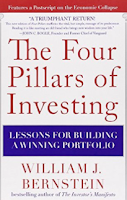
Review: The Four Pillars of Investing

I would strongly recommend anyone serious about investments start their education with this book.  I first read The Four Pillars of Investing (McGraw Hill, 2010) by Dr. William J. Bernstein a few years ago. I reread it recently in preparation for this review. Like any good book, new insights and appreciation emerged on rereading.

The Structure of the Book

The author uses an architecture metaphor, asking what pillars should underpin your investment portfolio. His four pillars are:
  1. Theory of Investing
  2. History of Investing
  3. Psychology of Investing
  4. Business of Investing
I was hesitant to even list these pillars in the review, as they make the book sound heavy and boring.  But it is not that at all! Rather, it is one of the most interesting investing books I have read!

Each of the themes is covered in a number of chapters.  For example, Chapter 3 "The Market is Smarter Than You Are", is his take on the efficient market hypothesis.  As well as providing the statistics to show that most funds will be, on average, well, approximately average, he makes the strong case that you can't pick stocks and you can't time the market successfully in the long term.

I particularly liked the historical depth of the book, not just in the second section but throughout.  He starts off the history section with the statement: "About once every generation, the markets go barking mad." I loved the many historical tidbits I learned, such as that Isaac Newton had big investment losses in the South Sea Bubble, or about the early 'stock exchange' in the coffeehouses of Change Ally. While these examples may be considered trivia, the historical aspects of the book help us place boom and bust, risk and reward, within a long equity history.

The above is not the only clever opening statement.  The psychology section starts "The biggest obstacle to your investment success is staring out at you from your mirror." In chapters 7 and 8 he offers insight on investment emotions, and practical advice on how to reign in investor behaviour issues. It is full of gems like
"...asset classes with the highest future returns tend to be the ones that are currently the most unpopular."
In answer to the question "To whom do I listen?", Dr. Bernstein offers the same advice of many others to tune out the investment noise. He then goes on to summarize with remarkable simplicity and clarity the two aspects  that you may well need guidance with.
  • Your appropriate asset allocation
  • Being self-disciplined in your investments
While the majority of the book is concerned with establishing the four pillars, closing chapters deal with putting it all together (his so-called investment "assembly instruction booklet'). While the specific advice must be placed within the context of the time that the book was revised, now almost 8 years ago, the general theme of using low cost passive index investments, appropriately diversified across different asset classes, remains as true today as when the book was written.

Why I Liked It

I find that too much investment writing tries to jump to just the answers - without first establishing a base to critically evaluate any proposals. This book fills that void.

The book will help you see investments within a long term historical trend, quantitatively establishes the importance of asset allocation, and helps you avoid paying too much for financial services and reign in your own worst tendencies.

The writing style is clear, engaging and, dare I say fun?  The historical tidbits, and statements of principles through analogy and metaphor, make the book feel light, while teaching you some critical investment truths. He wrote the book with that aim – to appeal to an audience that did not embrace mathematics.

In an earlier review of a different book, I mentioned that after reading a book I ask myself the following four questions.
  1. Was my time invested in the book, time well spent?
  2.  Do I have confidence in the validity and balance in the presentation? 
  3. Was I engaged in the book? 
  4. What were the author's motives in writing the book? 
I enthusiastically answer YES to the first three questions.  While any author hopes to have some financial success with a book, I feel that Dr. Bernstein, first and foremost, wants to help individual investors have success and avoid blunders.

The Author's Other Books

The author has been prolific in his investment writing, and you may well be interested in some of his other books. Prior to this book, William Bernstein wrote The Intelligent Asset Allocator, a more mathematically based book than this one.  I have not yet read it personally, but plan to.  It has received high praise from readers.

More recently (published in 2012) his The Investor's Manifesto covers some of the same theoretical underpinnings as The Four Pillars of Investing.  It is richer in mathematical basis, and of course more up to date in the current index investing landscape.  I hope to give it a full review in the not too distant future.

You can get a full list of his investing books on his website, http://www.efficientfrontier.com, including his Investing for Adults series which I have not read.

In case you were wondering about his background, William Bernstein followed work in science into a career as a medical neurologist.  He lives in Portland, Oregon, and for a number of years his efforts are invested in financial theory and history, and investment writing. The Globe and Mail did a nice interview with him that is available here.

Concluding Thoughts

If you are just getting started in investing, this book is the perfect place to start.  It will help you think about the big picture before you start considering advice for specific investment instruments. The book is interesting to read, and provides a solid grounding.  It's not surprising that it has a large number  of positive reviews on Amazon and similar sites.

Especially for Canadian investors, this is not a DIY manual though. After reading the book you will need to go to other information sources (dare we say including our website?)  for help in putting together a specific intelligent portfolio for your investment situation.

If picking up the book used, make sure you get the 2010 edition, and not the 2002 edition.  Both are still available on Amazon.  The 2010 version has a red bar across the top of the cover.

 If you use an eReader, the book is available in both Kindle and printed form. The ebook is also available on CloudLibrary, should you have an account through your local public library.

I have no hesitation in placing this book in the top few investment books you should read! Enjoy! As one of the reviews on Amazon commented:
"What sets this book apart from other investing books is the breadth of areas covered, and also the writing style which is both "understandable and entertaining". A highly recommended read for any investor regardless of level."
I agree.  Whether starting out in investing, or if you have been an involved investor for many years, or even if you are a professional financial advisor, you will find real value in this book.

This posting is intended for education only and should not be considered investment advice. The reader is responsible for their own financial decisions.  The writer is not a professional financial planner or investment advisor. For major financial decisions it is always wise to consult skilled professionals. While an effort has been made to be accurate, any statements of fact should be independently checked if important to the reader.

Disclosure:  No compensation by any company, organization or individual has been offered, requested or received for writing this column. We do however belong to affiliate programs for some of the links that you find in our articles, details available upon request.

Books for Review: I will not promise a positive, or even any, review, but if you wish to submit your investment book for me to consider, contact me rhawkes (at) chignecto.ca. I am particularly interested in Canadian books.


Sunday, April 9, 2017

Do XAW, VXC Represent Global Stock Market ?

Do you know what proportion of the global stock assets are represented by US markets? those in Canada? Europe? China? A surprising number of investors have either vague or out of date answers. This post will provide some data on the global equity space, along with reflections on how that might inform your investing choices.

While most investors exercise some degree of home country bias,  for a variety of good reasons, it makes sense to invest globally. In this posting I propose a simple idea: why not invest in different markets according to the size of those markets?

Some Data

The size of economies is somewhat different from the size of equity markets in those countries, and it is a good question whether we should use stock market or economy size. I will work with stock market valuations in this post.

There are about 60 stock markets globally, and their valuations are shown in a really nice data visualization here. You can get the raw data with the most recent statistics here from the World Federation of Exchanges.

Kim Iskyan wrote an article for Asia Wealth Investing Daily in November, 2016 that provides statistics (taken from Bloomberg) on the sizes and growths of different national stock markets, with a look at the top ten. You can read his report here courtesy of Stansberry Churchouse Research.

Not surprisingly the US stock market is the largest by a significant factor, at 36.3% of the total.   China was second, at 10.1%, followed by Japan at 7.9%, Hong Kong at 6.3% and UK at 4.6%. Canada, followed by France, Germany,  India and Switzerland complete the top ten.

 If we accept the premise of investing globally in proportion to equity assets, about 36% of your equity investments should be in the US, 10% in China (with another 6.5% in Hong Kong),  8% in Japan, about 3% in Canada.

The World It Is A Changing

The article cited earlier points out that a fairly dramatic change in the relative capitalizations of different markets is taking place.  For example, from October 2003 to 2016, the US stock market while increasing in an absolute sense, dropped as a fraction of global stock assets  from 45.2% to 36.3%. The big increases were all in Asia, with China going from 1.5% in 2003 to 10.1% in 2016, Hong Kong from 3.0% to 6.3%,  and India from 0.8% to 2.6%. Stock markets in Europe and Japan all fell as a global percentage. Interestingly the Canadian market, with a slight rise from 2.6% to 2.9%, was the only top 10 'developed' market to show an increase.

 Do XAW and VXC Represent World?

So how would you build an ETF portfolio consisting only of TSX listed ETFs that faithfully represented the entire global equity market. While specialized ETFs representing almost any market now exist, and you could build an ETF portfolio to almost exactly represent the world's equity markets, the MER would be high for so the many specialized products.

Most use ETF products like XAW from iShares or VXC from Vanguard Canada to represent most of the world.  These track different indices, with XAW tracking the MSCI while VXC tracks the FTSE global index.

Both XAW and VXC have excess weight on the US equity market, with XAW at about 54% and VXC at almost 56%, whereas the actual size of the equity markets suggest that only about 36% should be in US equities. Both under represent  emerging markets, with a total emerging market share of 11.5% in XAW and 7.8% in VXC currently. Note that VXC does not include any Canadian equity at all, so you should include at least 3% of your investments in a broad Canadian ETF such as VCN or XIC.

A simple way to make your global equity ETFs more representative of the entire world is to include about 20% of your holdings in XEC or VEE emerging market ETF (even though there are emerging holdings already in the XAW and VXC).  This would reduce the US holdings to about 44%, neareer to the 36.1% of the global equity assets, and similarly for other developed markets.

Another option would be to make up your global holdings using VEF (developed markets except the US, but including Canada), VUN (or some other widely represented US holdings) and XEC (or VEE) for the emerging markets component.  In this way you can adjust your US, other developed and emerging market holdings to the exact amounts you desire. If  Scotia iTRADE is your discount broker, VEF and XEC are both commission free to buy and sell, making this option even more attractive.  If you want to include China as a separate component, ZCH could be used, although remember you do have China represented in XEC or VEE. Also, the number of individual stocks within ZCH is limited.  If you want to add some Canadian home market bias (see below), XIC or VCN (or many others) could be added.

But I Want to Minimize Risk!

While it is natural to look backwards, as the excellent book The 3 Simple Rules if Investing reminds us: only look forward. It is true that volatility has in the past been greater in emerging markets. However, with high developed market equity valuations, unusually low interest rates, and political uncertainty in several developed economies, it can legitimately be asked whether the more governmentally controlled 'emerging'  economies such as China may offer lower future volatility.

Just as passive investors are urged to own all (or really a major part) of a domestic market,  it could be argued that the same principle would argue to hold most of the world equity assets proportionately in a global equity portfolio. 

Why Home Bias?

I'm sure they have been written, but I can't recall reading an investment commentary on the virtue, or lack thereof, of home bias.  This is a topic for a future column, but I considered reasons that you would want to show some home bias in your investments.
  • Your income needs are related to the inflation rate in your home economy, so significant Canadian holdings make sense.
  • As we argued in a post about holding individual stocks, it makes sense to invest in what you best understand, and that for most is the Canadian market.
  • While government intervention is only one of many factors, it does influence the rewards and risks of different types of investments. You will understand the political climate of your own country best.
Only you can decide what amount of home bias you want to have in your investments.  It probably makes sense to have less home bias in your accumulation phase than in retirement when you are withdrawing regularly from your funds.

Concluding Thoughts

Of course there are good reasons to not weight investments only according to the relative size of that countries equity assets.  For example, risk will vary in different countries. Also, average valuations, as expressed by P/E or other measures, may be significantly different in different regions.  Also, we know the North American stock market much better, and that familiarity might help us make better choices.

You should expect more than a rule of thumb about what fraction to be held in Canada, US and internationally based on the situation of ten years ago.  Make sure that your financial advisor discusses international holdings, and in particular emerging economies, in a current, evidence based fashion. If you do decide to have extra North American assets, make sure that it is a deliberate choice.

The international ETF space continues to change, so make sure to investigate the holdings of each ETF with current data before you make any decisions. We will be reviewing emerging market ETFs in a future post.


This posting is intended for education only and should not be considered investment advice. The reader is responsible for their own financial decisions.  The writer is not a financial planner or investment advisor, and reading this column should not be interpreted as obtaining individual financial planning or investment advice. For major financial decisions it is always wise to consult skilled professionals. While an effort has been made to be accurate, any statements of fact should be independently checked if important to the reader.

Disclosure:  The author of this column holds the following ETFs mentioned in this article in one or more account I manage: XEC, XIC, VCN, VEF and VXC.  I use Scotia iTRADE discount brokerage services.  No compensation by any company has been offered, requested or received for writing this column.